


Automated sample feeding for dry and wet dispersion in particle analysis
A high sample throughput requires standardised and automated sample feeding in the laboratory to reduce the workload on laboratory staff, with the option of preparing numerous samples in a single step. The MULTISAMPLER and Cobot are two automation solutions for dry and wet applications that meet these requirements. Both systems work in combination with the HELOS laser diffraction sensor for particle size analysis and the QICPIC image processing sensor for determining particle size and shape.
Structured sample handling for reproducible results
Automated sample feeding increases the efficiency of particle measurement technology in the laboratory and ensures consistent measurement conditions across entire sample series. The samples are prepared in a single step and are removed from a rack in batch mode and fed to the respective dispersion unit and measurement zone in a controlled manner. Manual monitoring or intervention is not necessary during the measurement series.
Method-guided processing ensures that dispersion and measurement parameters are implemented reproducibly. This supports a reliable data basis, particularly for measurement series involving a large number of samples. With MULTISAMPLER and Cobot, two automation solutions are available that are tailored to different requirements in terms of sample capacity, system integration and flexibility. Both systems handle the structured processing of prepared sample batches and contribute to the consistent quality of the measurement results.


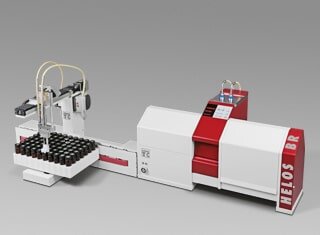
Automated sample handling in batch mode with MULTISAMPLER
Up to 70 sample vials, each containing up to 39 ml, are fed out of a rack to the sensors. The single samples are identified by laser engraved DataMatrix codes. This enables a direct assignment of dispersion and measuring procedures by software, if necassary different for each sample. For the optimum protection of the sample, the vials are made of brown borosilicate glass. They are reusable, as the DataMatrix code is laser engraved into a ceramic substrate. The vials are sealed by PTFE-silicon septum caps with nearly universal chemical resistance. If 70 samples should not be sufficient, the number can be doubled to 140 by using the Rack-Extension option.
If MULTISAMPLER/wet is used for samples to be measured in wet conditions, a specially designed sampler with a double injection needle is used. This instrument is able to feed particles up to 1 mm in diameter. This will ensure that the complete sample is analysed. The septum-caps prohibit a contamination of the environment by the sample or the dispersing media. If appropriate cleaning-cycles are added to the control-program and a switch of the dispersing media is possible offering a flexible adaption to the application.
MULTISAMPLER/dry is best suited for dry samples in combination with dispersers of the RODOS family. In this case a specially designed sampler uses the vacuum generated by RODOS to fluidize and transport the sample. Particle sizes up to 1.5 mm are possible. Again, the special shape of the V-vials in combination with a cyclone-like sampling nozzle enables an almost complete emptying.
Sample transport and sample handling are performed by precise servo drives. As handling times of only some seconds are achieved large numbers of samples can be analysed with nearly no idle-times.
A fully automatic sample handling system for high sample throughput is available with MULTISAMPLER. In batch operation up to 70 vials with 39 ml volume each are fed from a tray into the system. Sample identification is achieved with a data matrix code etched to the bottom of the glasses. The complete amount of sample is captured into the airflow of the RODOS injector, dispersed in a free jet and measured by the laser beam.
The combination of QUIXEL and MULTISAMPLER supports efficient laboratory analysis with high sample throughput. The system can run up to 70 sample glasses with 39 ml each without operator input. The glasses, which are sealed with silicone septum, carry a data matrix code for sample identification. Two peristaltic pumps operate simultaneously to fill and empty the vial.
Flexible automatic sample feeding with Cobot
The Cobot system adds a flexible, modularly integratable solution based on collaborative robotics to the MULTISAMPLER portfolio. It is particularly well-suited to laboratory environments where samples consist of coarser particles of varying sizes, which consequently require a larger sample volume, particularly during dry dispersion.
In its standard configuration, the system processes up to 32 samples in batch mode. The samples are stored in a compact rack and the robot removes them sequentially. The number of sample positions, rack geometry, vessel types and closure types can be adapted to meet specific customer requirements. Sample identification systems can be interated as an optional extra. This enables the automation to be tailored to existing laboratory processes.
The cobot handles the automated transfer of samples between the rack, dispersion unit and measuring zone. Each sample is removed in an application-controlled manner and fed to the mwasuring system. After measurement, the empty sample vessel is returned to its place. Measurements are performed in accordance with individual SOPs, enabling measurement series with different dispersion and measurement parameters to be carried out automatically. Dry and wet dispersion can be carried out in combination with QUIXEL, as well as with dispersers from the RODOS and GRADIS families.
Safety and integration
The collaborative robot is designed for safe operation in laboratory environments. The incorporation of emergency-stop functions and manual intervention options ensures a high level of safety in the immediate vicinity of laboratory personnel, obviating the need for additional structural modifications.
Thanks to its compact design, the Cobot system integrates easily onto standard laboratory benches and does not require additional floor space. Operation is carried out via predefined software workflows, enabling swift familiarisation and minimising training requirements. Therefore, series measurements require no operator presence during measurement, while maintaining consistent measurement quality.


